
The first three articles asked what to preserve as SaaS products accumulate, what an organization needs to remember, and how to keep that knowledge useful. This fourth article introduces DocQuater, a project built around those questions.
My responsibility spanned planning, architecture design and the overall agent-assisted development effort. The aim was to give the next person a place to ask questions and return to the basis for a decision, beyond simply storing years of documents.
Need — Start investigating without knowing where to look
When taking over a feature, a list of files is not always the first thing someone needs. Why was it designed this way? Has a similar problem occurred before? What should I read to understand the background? I wanted to make investigation possible without relying entirely on someone who already knows where everything lives.
Imagine looking into the reasoning behind a newly inherited feature: ask a question, read an explanation, open its sources and follow related knowledge. That is the kind of starting point I wanted to build.
Challenge — Stored information and useful answers are different things
Documents, development discussions and repository notes are written for different purposes. The background a future reader needs may not be gathered in one place. As material accumulates, selecting relevant passages and distinguishing older explanations becomes part of the work.
Fluent generated text alone does not make a handover dependable. The experience needs both a way to check an explanation and room to acknowledge that an answer could not be found.
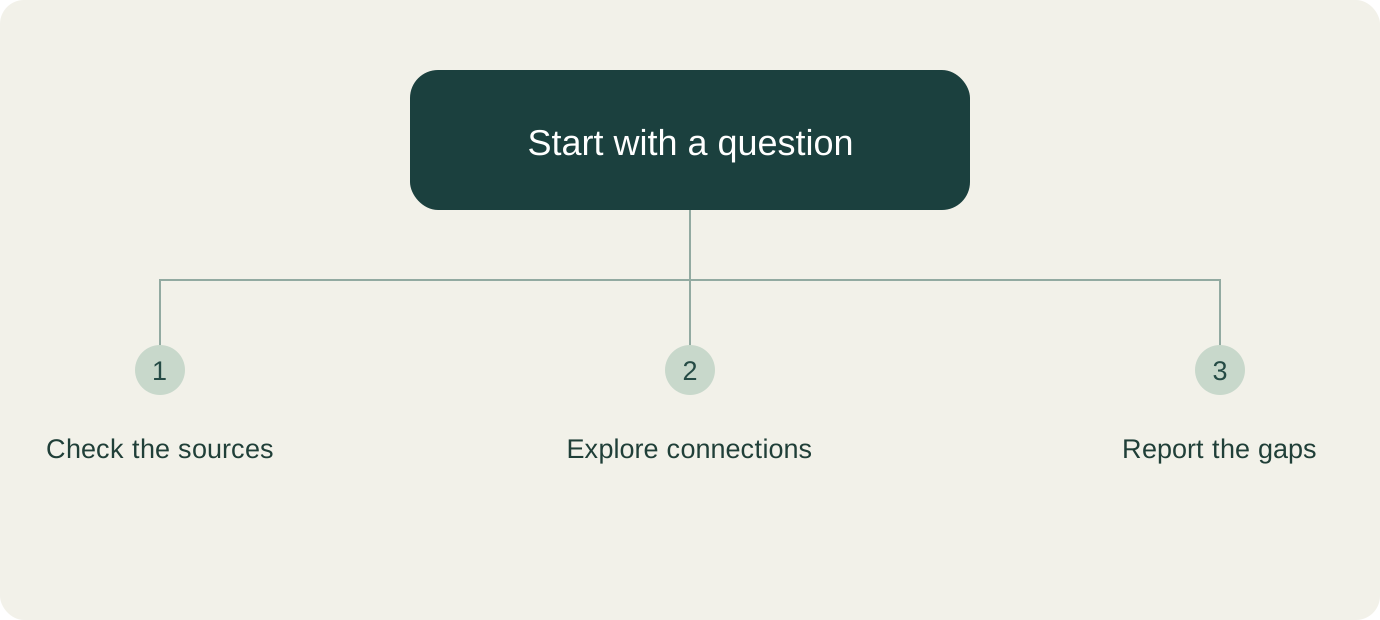
Approach — Keep explanations close to the means of checking them
I combined natural-language questions with answer sources and ways to explore related knowledge. Reading, asking and viewing connections offer different entry points. I wanted people to be able to follow the background for themselves.
Feedback and unanswered questions matter too. Seeing where someone got stuck and what was missing helps identify the knowledge that needs attention next.
In designing the architecture, I considered preserving source information, organizing knowledge and helping people consult and check it as distinct responsibilities. I also combine local LLMs with cloud-side models and agents according to the work I want them to do.
This connects to the idea of growing knowledge in Part 3. What I want to keep tending is the knowledge, explanations and connections people turn to in their everyday work.
MCP — Connecting the agents each member works with
I gave DocQuater an MCP server so that compatible agents used by individual team members can connect to it. The aim is to make organizational knowledge accessible through conversations with the agents they already work with.
I believe those conversations also hold knowledge that has never been recorded. As people ask, answer and talk, the reasoning behind a decision or a practical insight can come into words. These are experiences that reading repositories and task management systems alone cannot reveal.
I want to check those contributions and connect them to organizational memory. Background shared by one person can become a clue for someone else later, without repeating the same explanation from person to person.
My ambition is to bring that information-sharing overhead as close to zero as possible. I want conversation to leave knowledge that supports the next piece of work, and to grow a second brain for the company in that way.
Design — A cosmos as a landscape of memory
I designed the frontend around a theme I called “Pillar of Creation.” By bringing the scale of the cosmos together with the idea of a neural network, I wanted to convey scattered information forming relationships.
Following connections visually and moving from a question to its sources belong in the same experience. That is the intent behind the design.
Result — Questions, evidence and connections in one experience
Answers with sources, a graph for exploring related knowledge, feedback and guidance when relevant material cannot be found: I brought these together into one experience. I wanted people to have somewhere to check an explanation and a way to notice what was missing.
For me, the meaningful step is moving from an entry point for finding documents to one for moving between questions and evidence. I want to keep developing it through how people use it in handovers and everyday investigation.
Future — A brain that connects specialist projects
What I want to explore next is connecting DocQuater with specialist projects such as Fabric Drape Generater. Bringing accumulated fabric knowledge together with capabilities for producing drape imagery could extend a conversation from what we know to what we can explore and create.
I picture DocQuater connecting the knowledge and capabilities of those projects: reaching the right expertise or function when it is needed, and covering more ground as experience accumulates. That is the organizational brain I have in mind when I imagine an all-round expert.
Back to the first question
Passing on a product's value requires leaving clues to understand it, as well as something that runs. DocQuater is my practical work toward that goal.
For me, an organizational second brain should help the next person check what they find and continue making informed decisions. That brings this series back to its first question: what should we preserve and pass on?
Banner: AI-generated concept art, Pillars of Memory. Body diagram: a conceptual view of the user experience.